
Businesses today operate in a more connected world than ever. For many UK companies, managing money in multiple currencies is now the norm – from settling an invoice in US dollars to paying a remote hire in euros.
But foreign currency left to sit in a low-interest account loses value to inflation, limiting the ability of CFOs and Finance Directors to absorb unexpected costs.
In this article, we share five practical strategies to help you earn more interest on your foreign currency reserves.
UK businesses are trading internationally more than ever
International trade is a significant part of the UK economy. It drives economic growth, creates jobs, and allows companies to become more productive by reaching larger markets.
That impact is growing. UK trade reached £1,939.2bn over the year to May 2026, up 4.2% on the year before according to research commissioned by the UK government.
UK trade at a glance
Measure | Value | Change year on year |
Total trade | £1,939.2bn | +4.2% |
UK exports | £946.6bn | +3.1% |
UK imports | £992.7bn | +5.3% |
*Source: gov.uk, 12 months to May 2026.
European Union and the United States remain the UK’s two largest markets
The US is the largest single trading partner for the UK, accounting for 21.8% of exports and 13.3% of imports. Taken as a bloc, though, the European Union is the UK’s largest trading partner overall, making up 41.4% of exports and 49% of imports.
The UK’s trading relationship with the EU has changed since Brexit. Leaving the EU single market and customs union increased red tape, customs checks, and trade barriers.
For a business trading with the EU, that means higher costs and more admin. This makes it worth paying closer attention to how your business manages any foreign currency cash.
Your foreign currency balances deserve the same attention
Today, 234,000 UK businesses have multinational operations spanning 128 countries, and 84% of them are small and medium-sized enterprises (SMEs). Businesses of every size operating in today's economy face the reality of scaling across borders, not just large corporations.
Whether you're importing wine from France or employing a small engineering team in Poland, doing business internationally usually means more invoices, more payments, and funds held in multiple currencies.
Different banks, complex management
Some businesses hold foreign currency with a different bank, sometimes UK-based, sometimes overseas. This can mean more accounts to monitor and less visibility over the total cash position, and without active oversight, balances can sit idle earning little or no interest.
Others opt to keep things simple with a multi-currency account. This makes day-to-day management easier, but it can concentrate risk with a single banking partner and often means accepting whatever rate that bank offers.
In either case, if you want to protect your money and earn a competitive return on it, it's not enough to leave cash sitting in low or no-interest accounts. Actively managing your cash is one of the most effective ways to ensure it keeps earning. And there are ways to make this scalable.
Five strategies to earn more interest on your foreign currency
Consider a cash platform like Flagstone
Reviewing rates, tracking maturities, and onboarding with multiple banks across multiple currencies takes time. But a cash platform like Flagstone brings everything together in one place, replacing several separate bank logins with a single view of your foreign currency position.
This makes it easy to compare rates, move money freely between accounts, and safeguard your funds.
By making USD and EUR savings portfolios available to any business, we are equipping our business clients with an even easier, faster cash management solution that works across currencies, freeing up teams to get back to scaling their businesses in whichever direction they choose.
Stay on top of the market
Interest rates on multi-currency accounts vary between banks, and they can change. The account that worked well for you last year may not be the strongest option today. Keep an eye on the market and review your options regularly, so you're ready to take advantage when a better rate appears.
Lock funds away where you can
If you know a chunk of your foreign currency funds won't be needed for a while, a Fixed Rate account typically has a higher interest rate than an equivalent Instant Access one. In general, the longer the term, the higher the rate. The trade-off is you can’t access funds before maturity.
Stagger your maturity dates
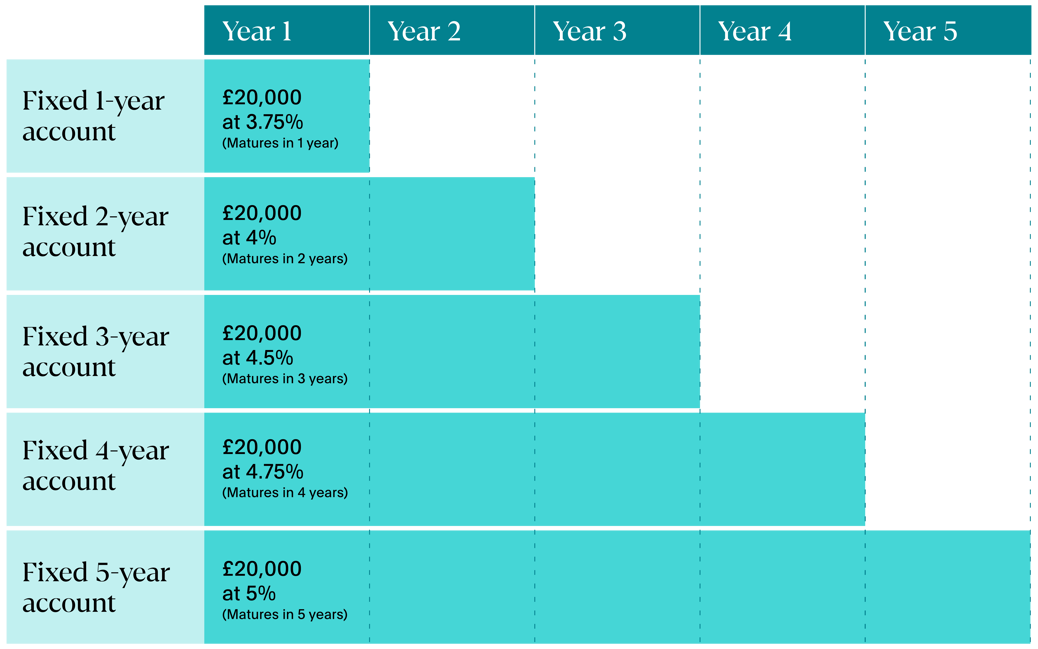
Rather than locking your foreign currency balances in one Fixed Rate account, you can spread it across multiple accounts, each maturing at different times. This laddering strategy gives you regular access to your funds while taking advantage of competitive rates.
Here’s how laddering works:
Diversify to enhance protection
Growth is important, but only once your money is safe. If you have over £120,000 in foreign currency, holding it with one banking group means any amount above that threshold is unprotected if the institution fails. Spreading your cash across multiple accounts and banks can help you maximise Financial Services Compensation Scheme (FSCS) protection.
Extra currency, no extra admin
Holding foreign currency is an integral part of many business operations. With Flagstone, you can secure your GBP, EUR, and USD cash balances all in one place, earning competitive interest rates from a range of UK banks.
Diversify effortlessly across a growing panel of FSCS-eligible banks, while gaining a clear, multi-currency view of your cash position and FSCS coverage.