
Laddering involves spreading your deposits across a range of Fixed Rate accounts, each maturing at a different time. This way you can take advantage of the best available rates while keeping regular access to your funds.
The approach is catching on. Our research with Opinium* found that 64% of UK Small and Medium-sized Enterprises (SMEs) now stagger their cash reserves across accounts with different maturity dates.
The timing is no accident. Access to finance remains tight, borrowing costs are high, and the general cost of doing business continues to squeeze margins. With geopolitical uncertainty slowing growth investment, many companies are looking inward at the cash they already hold.
In this article, we explore how laddering works, what it could earn compared with regular saving, and a real-life example from a marketing agency.
How does laddering work?
Instead of locking your full reserves away in one Fixed Rate account, you spread them across several 'rungs', each maturing at a different time.
Let's say you have £100,000 in cash reserves. Here's how you could deposit those funds into savings accounts with different maturity periods and interest rates:
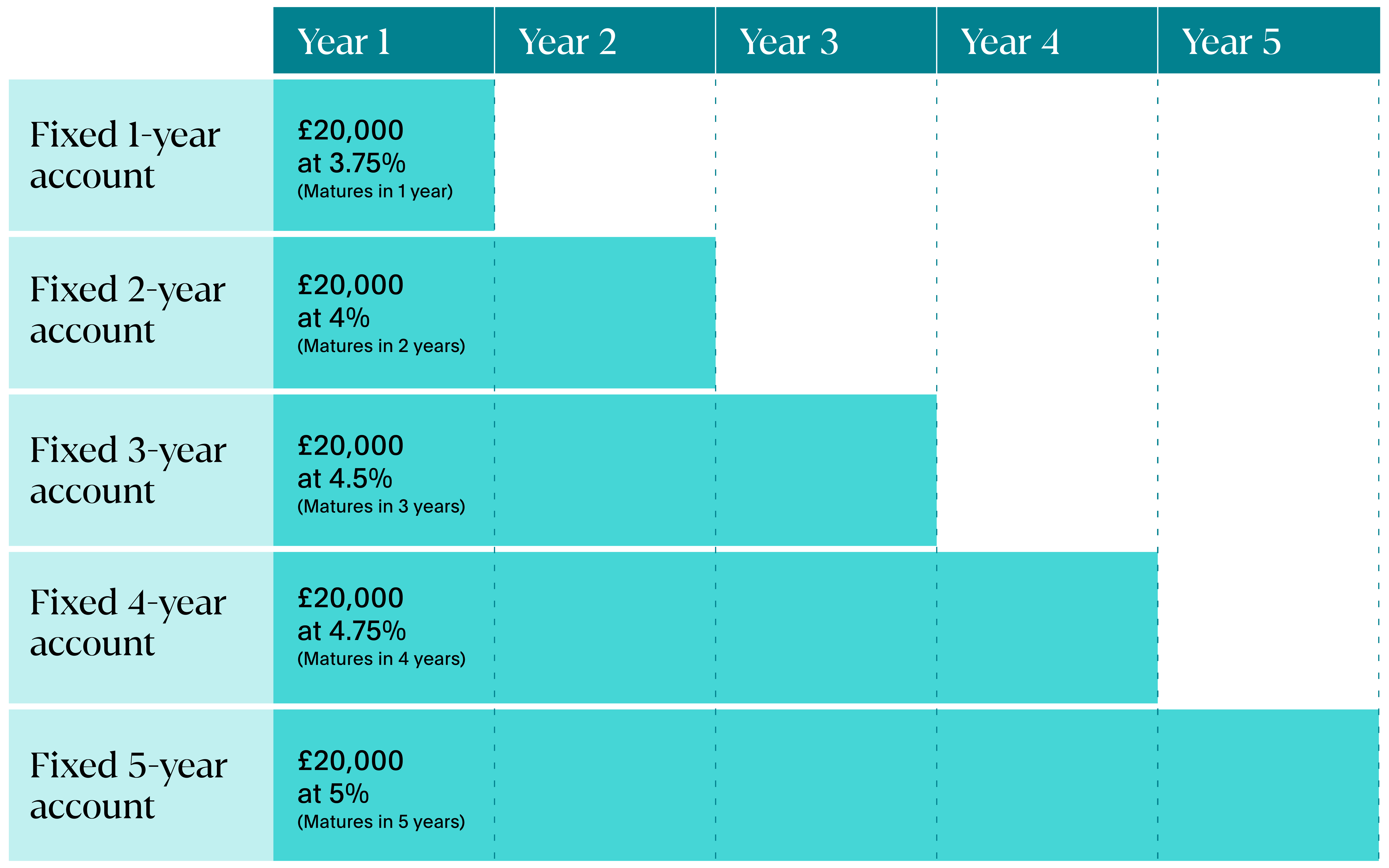
As each account matures, you can access the money or reinvest it into a new account with a longer term and usually a higher interest rate.
The benefits of a laddered approach
It gives you flexibility without sacrificing returns
A laddered strategy solves the trade-off that puts many businesses off fixed term savings. Longer terms tend to pay more, but locking everything away creates a liquidity risk. A ladder gives you access to higher rates while cash keeps flowing back at predictable points.
Most businesses run a ladder alongside an Instant Access account that covers day-to-day outgoings such as payroll and supplier payments.
It helps you grow your cash reserves
Our research* found that the average mid-sized SME holds £620,000 in cash reserves. Spread across multiple Fixed Term accounts earning an average of 4.30% AER (Annual Equivalent Rate)**, this cash could generate £26,660 in interest in one year.
Say you set up the ladder so one account matures each month, and you withdraw the interest each time. That's an income stream worth £2,222 a month. Or you could leave the cash to compound. Over five years, the total return could reach £145,267. Most business current accounts, by contrast, pay no interest at all.
It protects your money
Spreading cash across banking groups supports protection under the Financial Services Compensation Scheme (FSCS). All eligible deposits benefit from FSCS protection of up to £120,000 per person, per banking group. So, holding no more than that with any single group keeps your cash protected if a bank fails.
What the extra income makes possible
The research*** suggests businesses see cash management as a strategic lever, not an admin task. UK SMEs agree that a good cash management plan is important to achieving key business goals:
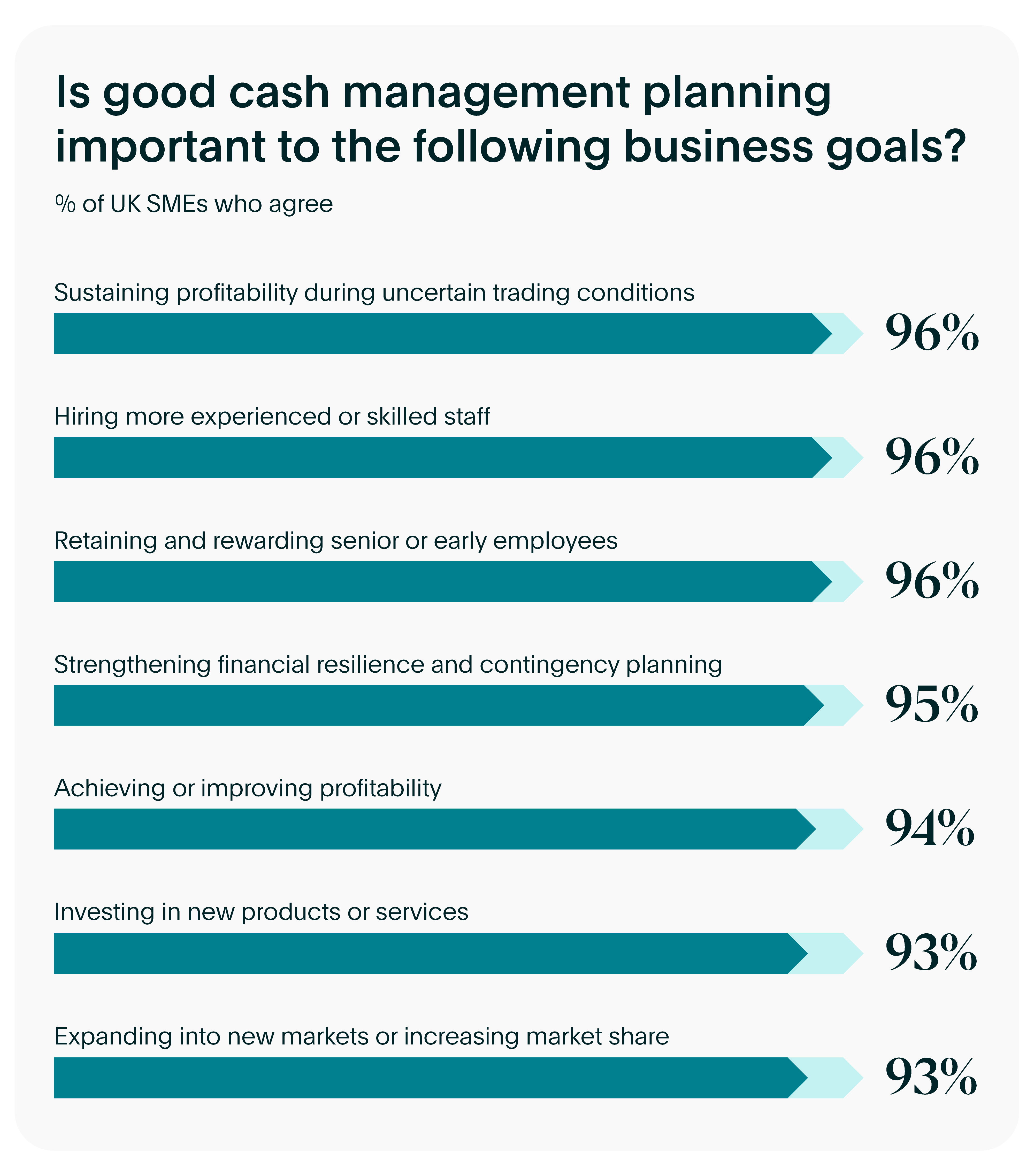
‘From helping them to achieve or sustain a profitable financial position to investing for growth in new territories or product lines, the opportunities for businesses feel endless,' says Lakhbir Sandhu, CFO at Flagstone. 'Better cash management also frees up more funds for companies to simply say thanks to the people who work hard for them.’
How a marketing agency turned static reserves into a revenue stream
Aaron Crewe founded Novi Digital, a performance marketing agency for B2B and luxury brands, in the North West in 2009. Today the agency has six full-time employees working remotely across the UK.
Aaron and his team ladder their reserves to earn additional income every year, while keeping plenty of liquidity and spreading funds across banks to stay within FSCS limits. The interest comes in on top of client revenue. It gives the agency extra resilience, at no cost to it.
By staggering the cash we don't anticipate any short-term need for, we've turned a pool of static reserves into a valuable revenue stream that supplements our income from clients.
Aaron spreads cash reserves between up to 12 savings accounts at any time:
3-4 Instant Access accounts cover the company's operating costs and tax bills.
6-8 Fixed Rate accounts of up to two years hold the rest – with one maturing every few months.
At each maturity, the team withdraws some or all of the capital and interest, or redeposits it into a new Fixed Rate account to keep earning.
The strategy grew up with the business. ‘When I launched Novi Digital 16 years ago, we managed our cash reserves manually and far less strategically,’ Aaron says.
As reserves grew, leaving a sizeable balance in a single low-interest Instant Access account came to look like ‘not only a risk but an opportunity cost.’ So, the team mapped out its ‘worst case’ liquidity needs, then built the ladder around them.
In Aaron's words: ‘We've taken what could be a deeply passive approach of just rainy-day fund maintenance and turned it into an income-generating vehicle that requires limited oversight and management for the extent of the benefit it creates.’
Learn more about how Novi Digital uses Flagstone to simplify and grow their business savings.
Open multiple savings accounts with Flagstone
Give large sums of business cash the growth and protection they deserve. Diversify across hundreds of high-yield accounts from 50+ FSCS-eligible banks. All in one platform, with a single sign-up, and a £100,000 minimum deposit.
Use our illustration tool to see how you could spread, secure, and grow your business cash with Flagstone.