
For most finance leaders and business owners, cash management is a constant balancing act: keeping enough liquidity on hand to stay operational, without leaving too much sitting idle where it can lose value to inflation.
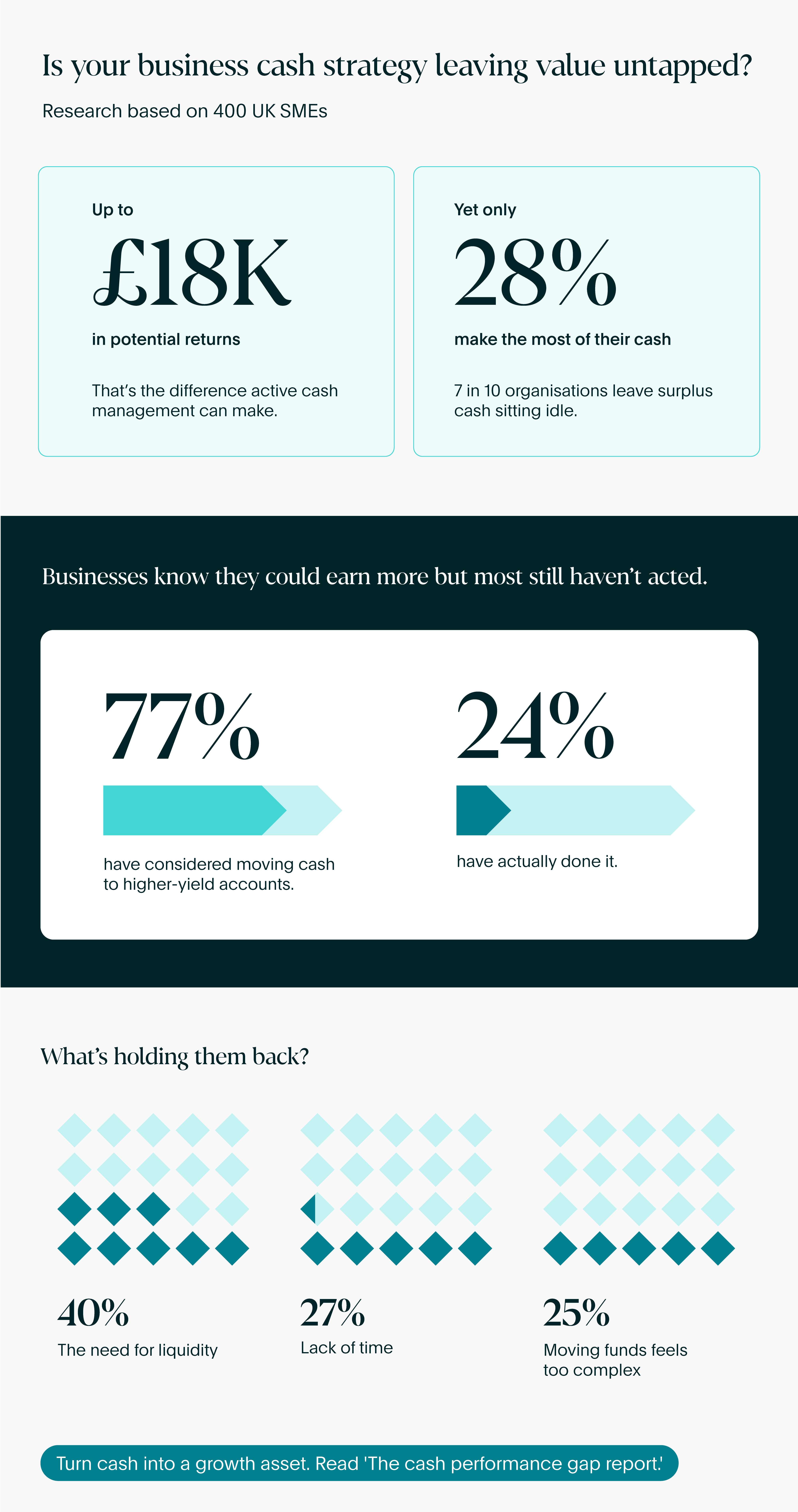
Our research found that 64% of organisations hold surplus cash in current accounts to keep it accessible – often at the expense of earning interest.
A cash segmentation framework provides a more structured approach. Rather than treating your reserves as one single pool, it divides them into three tiers based on purpose and access needs. The result is a clear strategy to help you protect liquidity while improving returns.
In this guide, we cover how the three-tier cash framework works and how it can help turn your reserves from a static resource into a growth asset.
The opportunity cost of idle cash
As economic uncertainty and volatile rates reshape business priorities, UK SMEs are holding more cash. But many aren’t making the most of it.
Our latest research, The cash performance gap report, found that UK SMEs that actively manage their funds could earn up to £18,000 more in interest a year that those that don’t. Yet seven in ten businesses keep surplus cash in low-yield accounts.
With rising costs and inflation still above target, those returns are increasingly hard to ignore. For most businesses, that's money that could fund new equipment and tools, support growth, or help to build financial resilience.
The reason for this inertia isn't awareness. Most finance leaders (77%) know their cash could be earning more and are seeking better rates, but only 24% have acted. The top barrier holding them back is the desire to keep funds easily accessible.
Businesses don't have to choose between earning interest and having funds available. That's exactly where the three-tier cash framework comes in. This model is particularly valuable if you need to maintain liquidity for operational purposes but also want to ensure that your surplus cash is earning interest.
The three-tier framework for managing business cash
Every business relies on cash to cover day-to-day costs, weather unexpected events, and fund future growth. But not all of it needs to be in the same place.
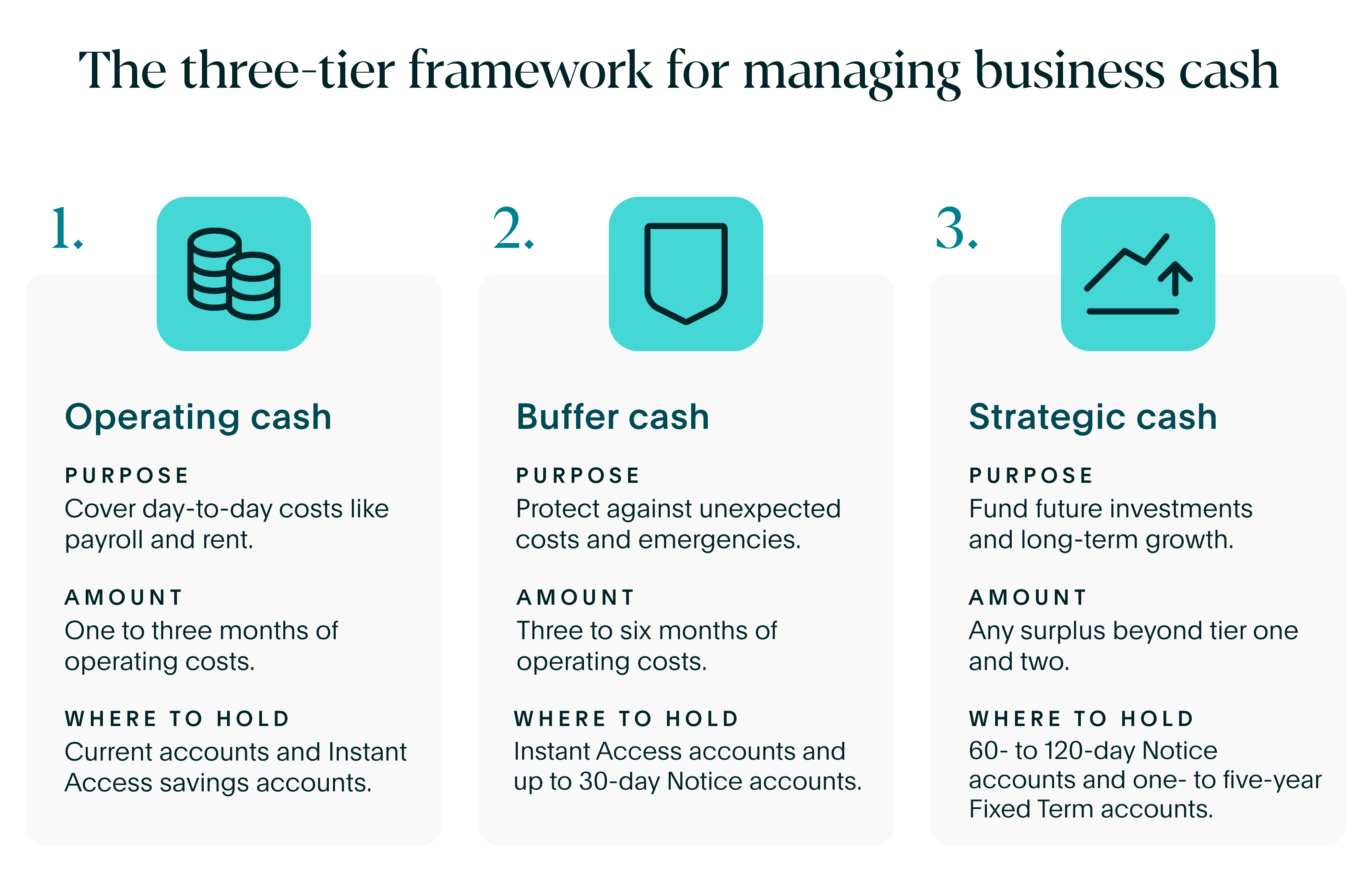
The three-tier cash framework follows a simple principle: different funds have different purposes and require different strategies. By dividing your reserves into three buckets – operating, buffer, and strategic – you can allocate cash to balance security and growth.
Here's how the framework works.
Tier 1. Operating cash
Operating cash is the most liquid tier of your financial strategy. It demands the most immediate access to funds to ensure your business can meet its day-to-day obligations without disruption.
• What it covers: money for day-to-day expenses and core business operations, including payroll, rent, utility bills, and marketing.
• How much to hold: a common rule of thumb is one to three months of operating costs. The right amount depends on the scale of your business, but the principle is the same: keep it to what you need to cover immediate expenses. Any surplus cash sitting here could lose purchasing power to inflation over time.
• Where to hold it: businesses typically hold operating funds in a current account, where they're always within reach. Instant Access savings accounts can also work well, giving you the liquidity you need while earning interest.
Tier 2. Buffer cash
Every business faces periods when cash flow doesn't go to plan. In the UK, 38 businesses close every single day as a result of late payments. In addition to this, late payment impacts on the cash flow of small businesses. Having reserve cash puts you in control when revenue drops or unexpected costs arise.
• What it covers: buffer cash helps protect your business against unexpected events – from drops in sales and delayed customer invoices, to unanticipated business expenses and sudden economic shocks.
• How much to hold: three to six months of operating costs is the standard baseline for most SMEs. Businesses with less predictable revenue, or exposed to seasonal demand, should sit towards the higher end.
• Where to hold it: Instant Access savings accounts can be a good option. This money needs to stay accessible, but it can afford to earn a return until it’s needed. You can also consider short-term Notice accounts, which offer shorter notice periods, usually up to 30 days.
Tier 3. Strategic cash
Tiers one and two are about keeping your business running. Tier three is about funding what comes next. Because strategic cash doesn't need to be immediately accessible, it can be held in higher-yield accounts until you’re ready to use it.
• What it covers: funds set aside to move the business forward, like upgrading technology, expanding into a new market, or launching a new product. It can also cover longer-term financial commitments, like repaying a loan upon maturity.
• How much to hold: any surplus that exceeds your operating and buffer cash tiers. If your strategic cash is growing significantly, it may be worth considering whether some of it would be better deployed elsewhere in the business or invested for longer-term growth. A financial adviser can help you find the right balance.
• Where to hold it: with a longer time horizon, you can afford to prioritise returns over immediate access – while keeping your money safe. Long-term Notice accounts, with notice periods between 90 and 120 days, and Fixed Rate accounts, with terms ranging from one to five years, typically offer better returns in exchange for reduced flexibility.
Discover the latest rates available to Flagstone Business account holders.
How UK SMEs currently segment their cash
Cash segmentation is likely already part of how your business manages its reserves. Our data shows that nine in ten SMEs divide their funds across operational, buffer, and strategic needs. But while most hold money for day-to-day operations, fewer are applying the same discipline to their buffer and strategic reserves.
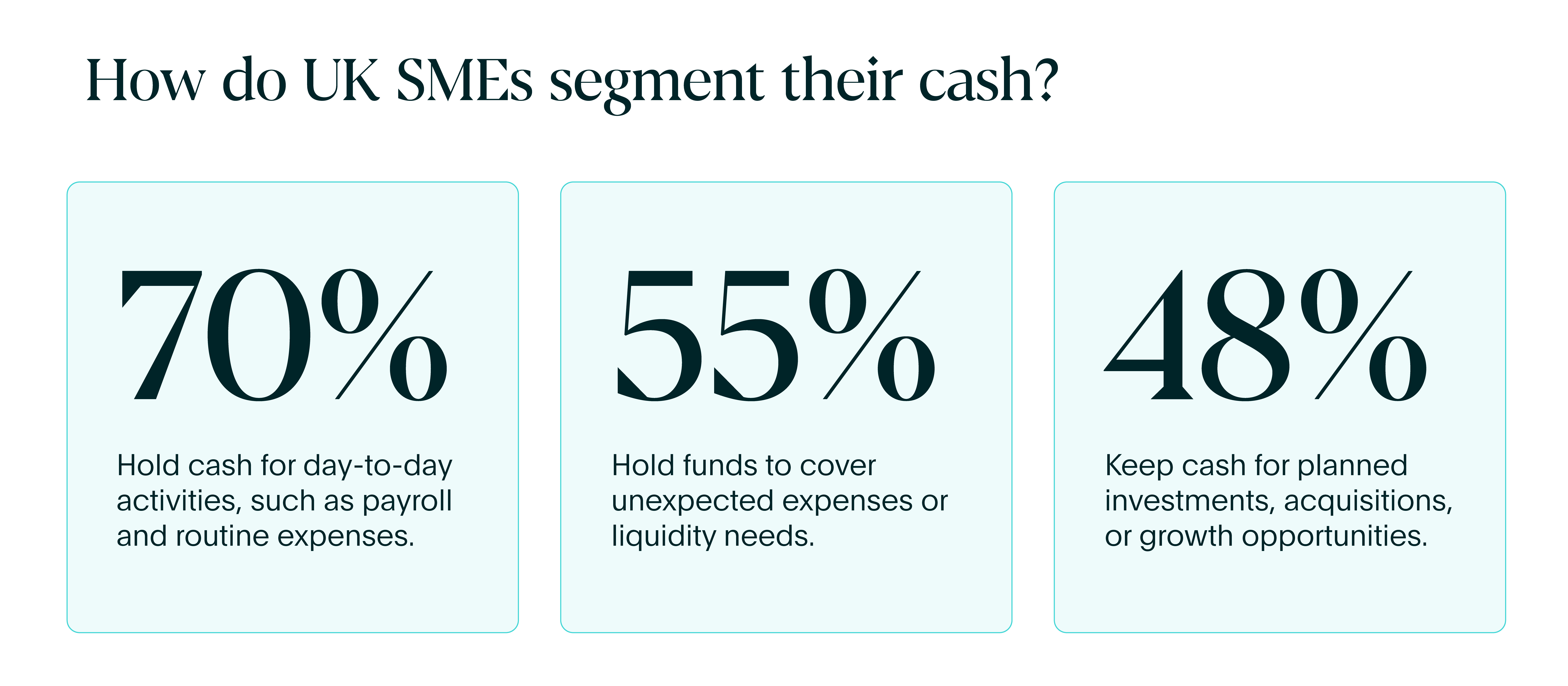
The picture shifts when comparing businesses that actively manage their cash with those that don't. Active organisations maintain a balanced approach across all three tiers – holding enough for day-to-day needs, maintaining a sensible buffer, and keeping funds available for future opportunities.
Passive organisations, by contrast, allocate most of their money to day-to-day needs. ‘Passive cash managers may segment their cash too unevenly for safety,’ says Lakhbir Sandhu, Chief Financial Officer at Flagstone. ‘Cash is mainly allocated to keeping the business running smoothly, but that limits flexibility to manage risk or pursue growth opportunities.’
Segmenting cash reserves by short, medium and long-term requirements can help businesses earn returns on their longer-term savings while maintaining liquidity for cash they frequently need.
How to implement the framework
Effective cash segmentation can help your business transform cash from a passive asset into an active component of your financial strategy. Here’s how you can apply the three-tier cash framework in four steps.
1. Assess your cash flow needs
Before dividing your reserves into tiers, you need a clear picture of how money moves through your business – how much comes in, when it arrives, and what commitments it needs to cover.
An accurate cash flow forecast is your starting point, covering everything from cash inflows like sales revenue and loans, to upcoming expenses like payroll and planned investments. Today, new tools and technology can automate much of this – so you can focus on strategic decisions rather than manually inputting data.
2. Define your tiers
With a forecast in place, you can segment your reserves based on when you’ll need the funds and their specific purpose. As shown in Image 1 above, companies typically divide their reserves across operating, buffer, and strategic tiers.
The exact segmentation will depend on a company’s industry, goals, and specific needs. A seasonal business, for example, may choose to hold more buffer cash than one with predictable year-round revenue. A business setting aside money to fund a planned expansion in 18 months will likely hold more in its strategic tier than one with no immediate growth plans.
3. Decide where to hold your cash
It’s generally a good idea to keep enough cash in your current account to cover day-to-day business costs. These accounts usually offer low or zero returns though, and any excess cash could earn more in a business savings account. These accounts offer different levels of flexibility and potential returns:
• Instant Access accounts: provide immediate access to your money, often at a lower interest rate than alternative accounts.
• Fixed Rate accounts: typically offer higher interest rates in exchange for locking your funds away for an agreed period.
• Notice Accounts: sit between the two, usually offering competitive rates with access to your funds after giving a notice period.
4. Review and rebalance
Cash needs fluctuate over time. A business might need to rebalance cash from its strategic to operating reserves following rising energy costs. Or it might choose to move excess operating funds into its strategic tier where they could earn more interest.
Regular reviews help ensure your cash continues to support your objectives, maintain appropriate protection levels, and sits in accounts that offer a better balance of access, security, and returns.
Discover how the managing director of a marketing agency built a high-yield cash portfolio with Flagstone, with no extra admin.
Transform your business cash into an asset
Having accessible cash on hand is essential, but leaving too much sitting idle comes at a cost. For many businesses, that can mean thousands of pounds a year in missed interest – money that could be reinvested into the company.
Segmenting funds by purpose is one of the most effective ways to bring clarity and control to your business finances – without adding complexity. The three-tier framework gives you a structure for understanding what your cash is for, how accessible it needs to be, and where it could be earning more.
Savings platforms like Flagstone make it easier to act on your segmentation strategy. You can hold cash across different account types to balance accessibility with returns, without compromising on either.
Build high-yield cash reserves across multiple banks with Flagstone
Spread, protect, and grow your company's cash with Flagstone. Access 50+ FCA-regulated banks and hundreds of high-yield savings accounts.
All with one sign-up, and a minimum deposit of £50,000, which you can spread across GBP, EUR, and USD. Trusted by 10,000 business leaders.