
Last updated: 21 July 2026
The complete guide to Inheritance Tax: at a glance
- What do I need to know? Changes to Inheritance Tax could reduce the amount your family keeps when you pass away, depending on how you’ve arranged your finances.
- What does it mean for me? Understanding the rules, how they could apply to you, and calculating the size of your estate can inform your discussions with financial advisers.
- Why does it matter? Learning how Inheritance Tax works can add useful context to help you plan what happens to your money.
When you pass away, it’s natural to want your family to receive as much help as possible. But if your finances aren’t arranged carefully, you could pay more to HMRC in Inheritance Tax (IHT) than you intend.
Changes announced in the 2025 Autumn Budget have made the landscape more complicated, adding uncertainty at a difficult time for your loved ones.
In this complete guide, you’ll learn the key considerations you should bear in mind when organising your finances to maximise the money you can leave to the next generation.
You’ll discover why households with significant cash savings could be at risk of an increased tax bill. You’ll also learn how certain types of property can expand the tax-free transfer potential of your estate, and why gifting early can reduce IHT costs for your loved ones.
What is Inheritance Tax and how does it work in the UK?
HMRC applies Inheritance Tax on your ‘estate’ above certain thresholds.
Your estate is the value of everything you own when you pass away. You pay Inheritance Tax on the amount you go over your allowances. HMRC charges a rate of 40% IHT on assets above the limit.
What do NRB and RNRB mean?
The nil-rate band (NRB) and the residence nil-rate band (RNRB) are the names of the two separate allowances that let you pass on some of your estate without paying IHT. The allowances are:
- NRB: £325,000 (fixed since 2009)
- RNRB: £175,000
What is the nil-rate band?
The NRB refers to the standard allowance that applies to most estates in the UK. It can apply to all types of assets within an estate, including cash.
Some gifts can use up your nil-rate band, depending on their type and how long you live after making them. The seven-year rule applies to NRB. This means the amount of IHT you pay on your estate depends on when you made the gift in relation to the date you pass away.
What is the residence nil-rate band?
The RNRB applies when your residential property is included within your estate. The seven-year rule doesn’t apply to the RNRB. So, you can still benefit from the full residential allowance even if less than seven years elapse between your gifts and passing away.
The amount of RNRB you receive can vary depending on your circumstances. You can calculate how much of the RNRB you qualify for using the HMRC website.
Taper relief
If the value of your estate exceeds £2m, HMRC gradually reduces your property allowance (RNRB), limiting the amount you can pass on tax-free. This is known as ‘taper relief’ (more on this later).
Some types of property, such as farms and some businesses, work under different rules. You’ll learn about that in greater detail when we cover the changes to Inheritance Tax that come into effect on 06 April 2026.
Potentially exempt transfers (PETs)
Gifting money and assets while living can reduce your Inheritance Tax, provided at least a few years elapse before you pass away. When you gift assets early, they’re usually designated ‘potentially exempt transfers’ (PETs), because they may or may not incur an IHT charge.
There are a handful of asset types that can’t qualify as PETs, such as certain types of woodland.
Why Inheritance Tax matters most for larger estates
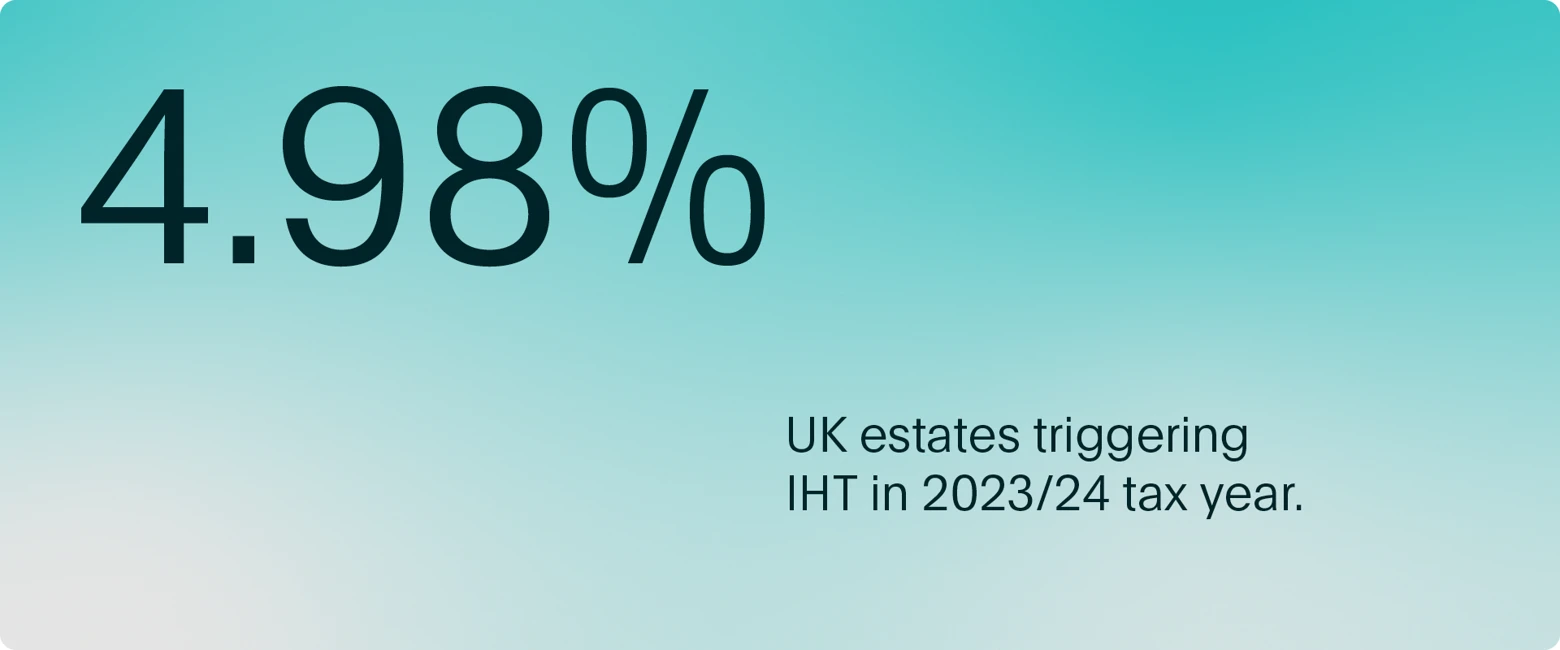
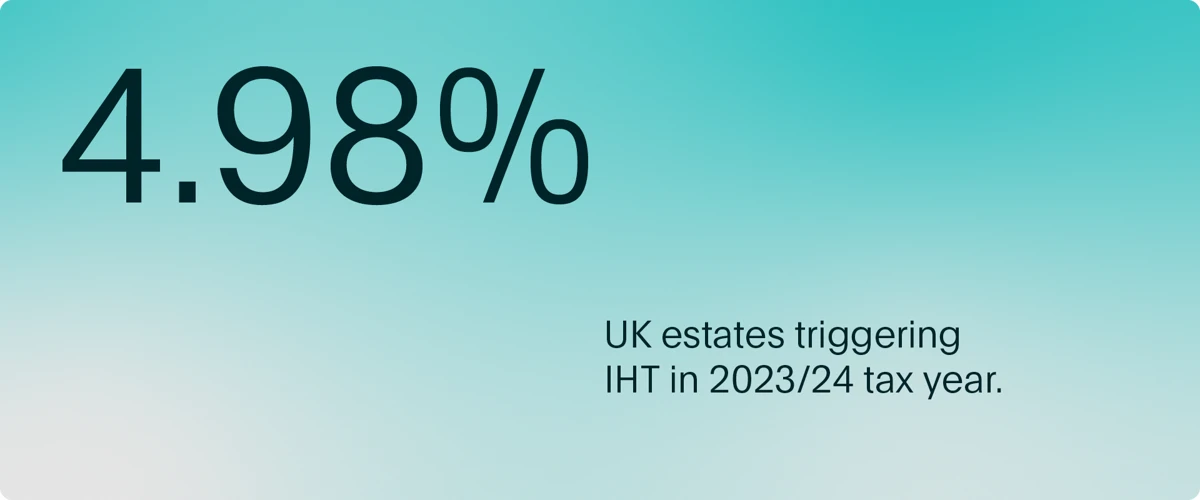
Most households in the UK are exempt from Inheritance Tax charges because their estate falls below the threshold. In the 2023/2024 tax year, fewer than one in 20 estates in the UK triggered an IHT charge, around 4.62% of the people that passed away.
This was up from 4.39% in the previous year. With the recent changes announced by the UK government in the 2025 Autumn Budget, that number is expected to rise even further.
Inflation, frozen thresholds, and rising property values combine to make a challenging environment for family wealth planning. Savers with large deposits in current accounts could be especially exposed, as the risks of low interest rates and high inflation reduces purchasing power every year.
The impact of significant cash savings on IHT
Estates with sizable savings in cash have specific considerations to take into account. For example, if you’ve maximised your annual Cash ISA allowances over multiple years, your accounts are likely generating a healthy level of tax-free interest every year.
But when you pass away, the tax-free status of your accounts comes to an end. The exact date your accounts lose their tax-free status depends. It can happen when the account is closed or when your estate is fully settled. HMRC counts the money you saved in your ISAs as part of your estate.
Earning more interest on your cash can help you build wealth during your lifetime, which is why opening multiple high-interest savings accounts is increasingly popular in the UK.
Interest earnings will also form part of your estate when you pass away in most cases.
The 2026 Inheritance Tax changes: What savers need to know
Changes announced in the 2025 Autumn Budget could also increase IHT charges for UK savers.
Frozen IHT thresholds extended to 2031
The UK government confirmed that the current thresholds of NRB and RNRB will remain in place for an additional year, until at least the end of the 2030/31 tax year. This is often referred to as a ‘freeze’.
While the announcement may sound positive initially, it could mean that estates pay more Inheritance Tax. This is because inflation erodes your purchasing power. Rising property prices can also push up the value of your estate without increasing your wealth.
Cash in low-interest accounts is especially vulnerable to inflation. This is one reason why opening multiple high-interest accounts can benefit savers looking to maximise their interest without sacrificing access to cash.
BPR and APR caps
HMRC will apply limits to the level of Business Property Relief (BPR) and Agricultural Property Relief (APR) from 06 April 2026.
Multiple changes and the final decision
The rules around Business Property Relief and Agricultural Property Relief have changed a handful of times.
When the changes were first announced in 2024, tax relief was set to apply in full up to £1m. Above this level, relief was reduced to 50%.
The 2025 Autumn Budget updated these rules so that the £1m allowance will become transferable between spouses and civil partners. In December 2025, the government announced that the allowance would increase to £2.5m per estate.
Lifetime gifting and the seven-year rule
Gifting money during your lifetime can sometimes help to reduce your IHT. You can choose to give money to loved ones early by making use of annual allowances, or the seven-year rule for much larger gifts.
Depending on how you pass on your gift it could be considered a ‘potentially exempt transfer’ (PET) or a ‘chargeable lifetime transfer’ (CLT).
The difference between PETs and CLTs
Most gifts or transfers of unlimited value are considered PETs. If you pass on a PET, and you live for seven years after making the gift, there’s usually no IHT to pay. This is because the gift is no longer considered part of your estate once that amount of time elapses. You’re only charged IHT on eligible PETs once you pass away.
CLTs are chargeable at the time you gift them. A CLT could include a payment you make into a discretionary trust. For example, if you paid more into a discretionary trust than your NRB, you’d pay Inheritance Tax immediately on the amount over the limit.
The rules governing trusts, and CLTs in particular, are complex. It’s highly recommended you speak to a financial adviser when investigating whether trusts are a viable strategy for your particular circumstances.
Small gifting allowances
There are some instances where you can make small gifts without needing to pay IHT. These include:
- Annual exemption: You can gift up to £3,000 a year without this getting included as part of your estate. You can defer this allowance once to gift £6,000 in one year. You can choose to gift the full £3,000 to one person or split the allowance between multiple loved ones.
- Small gift allowance: You can give as many gifts worth £250 per person as you wish, provided you haven’t used another allowance (such as the annual exemption) for the same person.
- Wedding gifts: Depending on the closeness of the relation, you can gift up to £5,000 to a family member when they get married. This can be £5,000 for a child, £2,500 for a grand or great-grandchild, or £1,000 to anyone else.
- Gifts out of normal expenditure: If you make regular payments to someone else out of your income, you can gift money without incurring an IHT charge. You need to pay consistently to qualify, and you must cover your own living costs first.
How to gift money to children with minimal tax
There are a handful of different approaches savers can take to minimise Inheritance Tax costs when gifting money to children. This often involves gifting money early as a potentially exempt transfer.
But it can involve setting up trusts or funding Junior Individual Savings Accounts (JISAs) depending on the age of the beneficiaries.
Popular methods for supporting children or grandchildren
- Lumpsum cash gifts: Depending on the circumstances, you can give some cash to close relatives without triggering an IHT charge. For larger lump sums, you can reduce IHT by gifting money early. This increases the chances that your PET will fall outside of your estate.
- Regular savings contributions: When a parent opens a JISA for a child, anyone can deposit money into the account on the child’s behalf. The limit for JISA contributions is £9,000 a year per child. A child can withdraw from an JISA once they turn 18 years old, at which point the account becomes an adult ISA.
- Trusts: Trusts allow you to share your wealth how you wish. Depending on how your trust is set up, you can either set conditions for when a loved one inherits your estate or hand over control to other people you choose. There are multiple types of trusts, each with complex rules. You should always speak to a qualified financial adviser when exploring whether trusts are the right option for you.
The changes to Inheritance Tax on pensions
From 06 April 2027 the UK government will start to include unused private pensions in IHT calculations. Your unused private pensions will be included in your estate unless you nominate a spouse or civil partner as a beneficiary.
What are the current rules?
Under current rules, pensions aren’t included in calculating the value of an estate. This means that you pay Income Tax when you withdraw a pension you’ve inherited, but not IHT.
Why pension planning matters for savers with over £100,000
Savers with larger cash deposits usually have a range of assets they can rely on during retirement. As a result, savers with significant cash may currently choose to maintain the tax benefits of leaving their pension untouched for longer.
But the calculations could change dramatically now that unused pension pots are set to become subject to Inheritance Tax in 2027.
This is especially the case if savers have built up a large pension fund during their career, which could raise the overall value of their estate above £2m when they pass away. Once that happens, taper relief comes into effect, bringing even more of their estate into tax.
Strategies to minimise IHT for savers with £100,000
The coming changes to Inheritance Tax could impact savers that have built significant wealth over the years. This is why it’s more important than ever to review how you’ve arranged your wealth and whether there are changes you need to make in the near future.
Understanding how you’ve currently structured your wealth can help inform your next steps. You can discuss your findings with a qualified financial adviser, making confident decisions about how you want to pass on your legacy to the next generation.
Calculate your Inheritance Tax
Work out how much of your estate could get taxed with Flagstone’s Inheritance Tax Calculator.