
If you’re responsible for a business and its finances, you’ll know how challenging the past decade has been. Brexit, the Covid pandemic, the cost-of-living crisis, and conflict in the Middle East have all left their mark.
Today, small and medium-sized enterprises (SMEs) across the UK are telling us that costs are rising on several fronts at once, from energy bills to payroll. In the race to protect their margins, business leaders are searching for efficiency wherever they can – and of all the available options, artificial intelligence (AI) appears to simultaneously hold the most promise and pose the greatest risk.
A survey commissioned by Flagstone asked 1,000 business leaders and financial decision-makers about AI. The responses highlighted the opportunity of the technology, what’s holding firms back, and the support they need to move forward with confidence.
AI is on the business agenda in a tough economy
Advances in technology mean AI tools are now widely accessible to businesses of all sizes. According to the British Chamber of Commerce, more than half of UK SMEs (54%) are using AI, up from 35% in 2025.
That rise comes at a critical moment. Our Business Barometer Report shows companies are raising prices, cutting operating costs, and delaying growth plans in response to energy costs and economic uncertainty. Under these financial pressures, 43% of firms doubt they can continue as they are for more than two years.
In this context, many leaders are rethinking how they work and AI is increasingly part of the conversation. The question is now where AI adds value and what stands in the way.
Larger businesses are more likely to see an opportunity in AI
Our research shows the majority of businesses (86%) see at least one opportunity from AI. That share rises with company size:
Micro businesses (1-9 employees): 70%
Small businesses (10-49 employees): 89%
Medium-sized businesses (50-249 employees): 94%
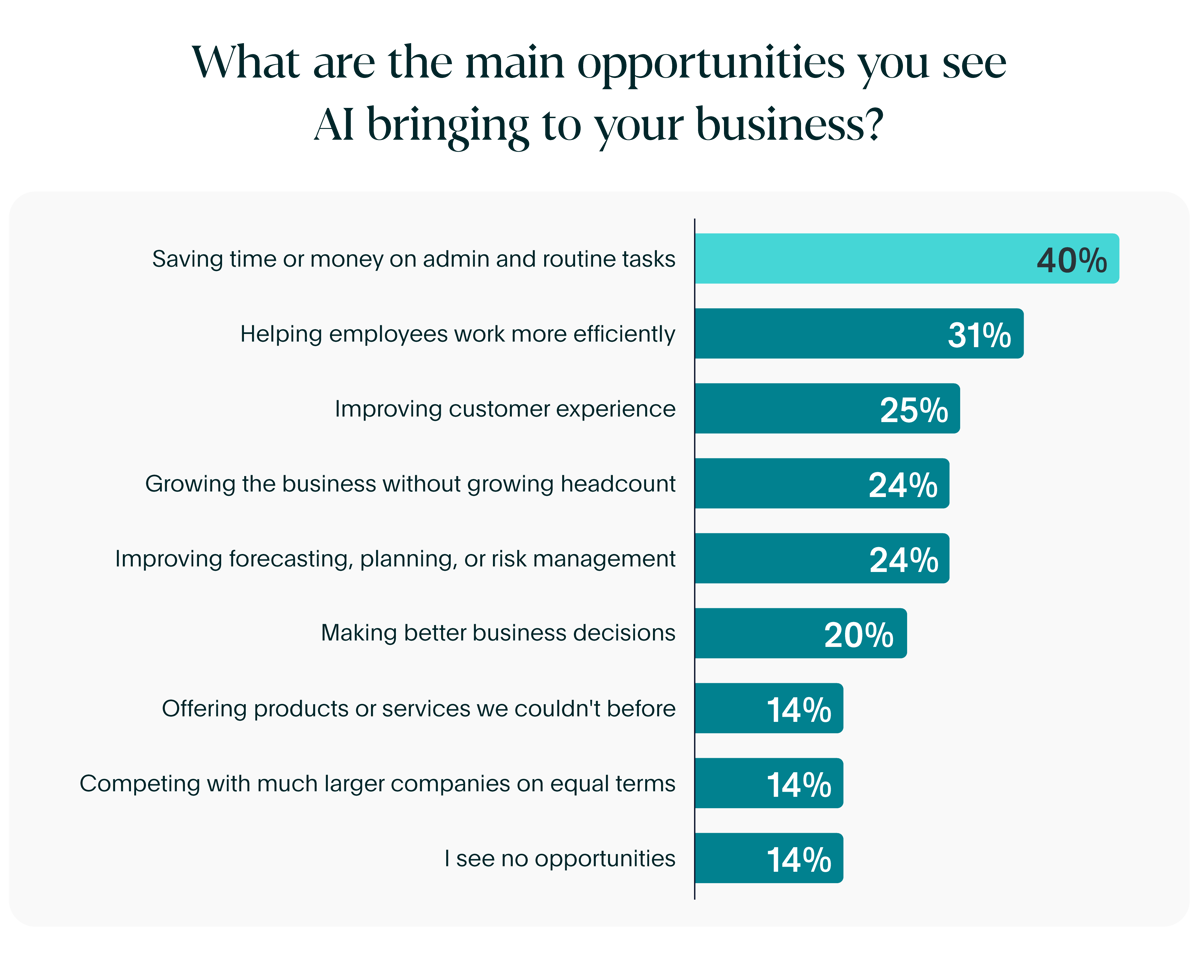
Most see AI as a practical tool for streamlining operations. The biggest opportunity is saving time or money on admin and routine tasks (40%), followed by helping staff work more efficiently (31%).
Fewer believe AI might change what they offer. Only 14% view AI as a tool to build new products or services, or to compete with larger rivals.
What’s holding businesses back
But optimism comes with caution. Almost nine in 10 businesses (85%) have at least one concern about AI.
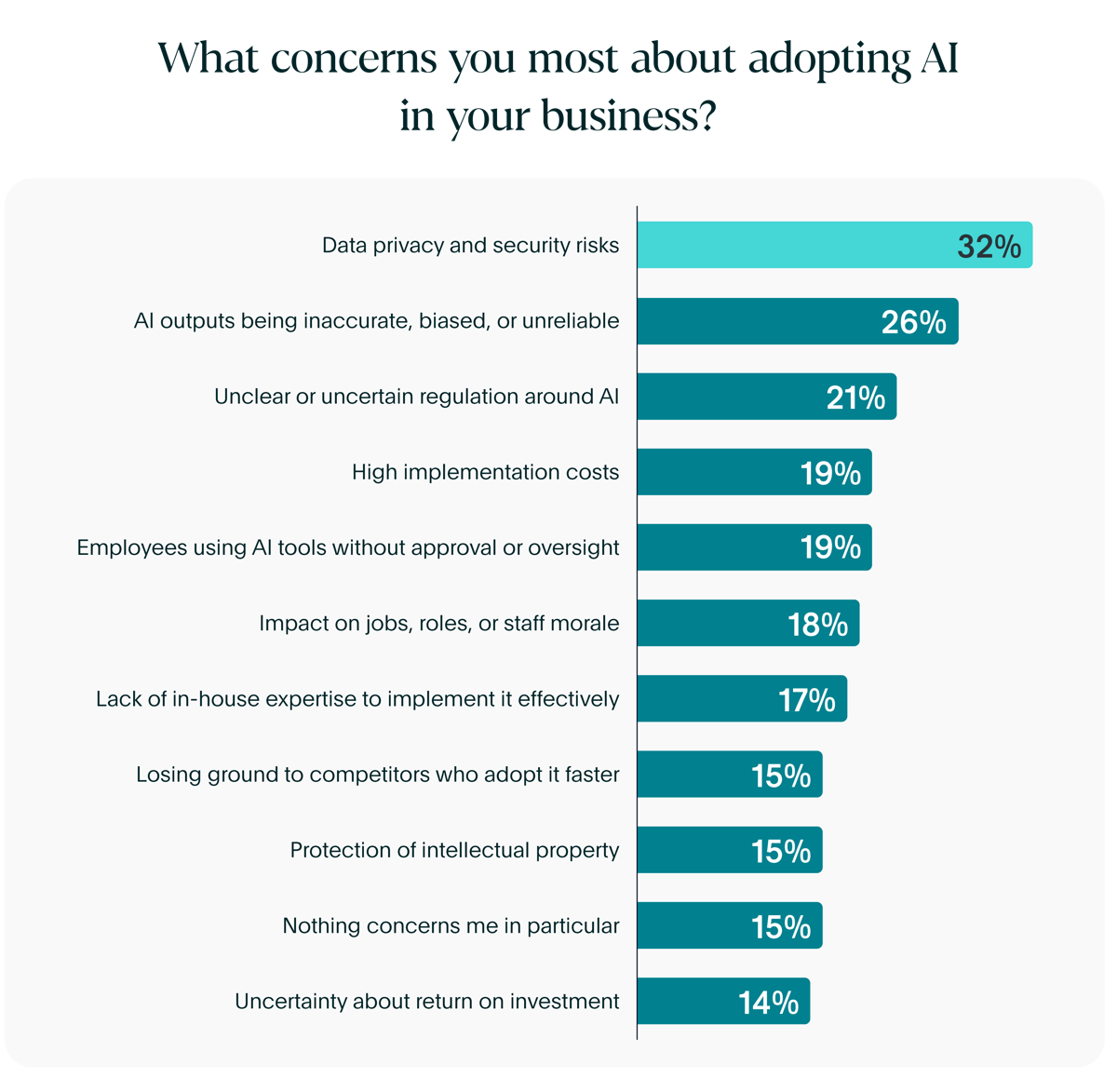
Data privacy and security risks top the list of worries (32%), followed by fears that AI outputs could be inaccurate or unreliable (26%). Around one in five (21%) point to unclear regulation.
High implementation costs are another hurdle, mentioned by almost one in five firms (19%). One healthcare business told us: ‘AI will be a great investment long term, but the setup cost is just too expensive for us right now’.
This new technology also raises questions around people. Some leaders (19%) are concerned about employees using AI without approval or oversight. A similar share (18%) mention the possible impact on jobs, roles, and staff morale, while 17% feel they lack the in-house expertise to make it work.
Businesses are asking for guardrails and practical support
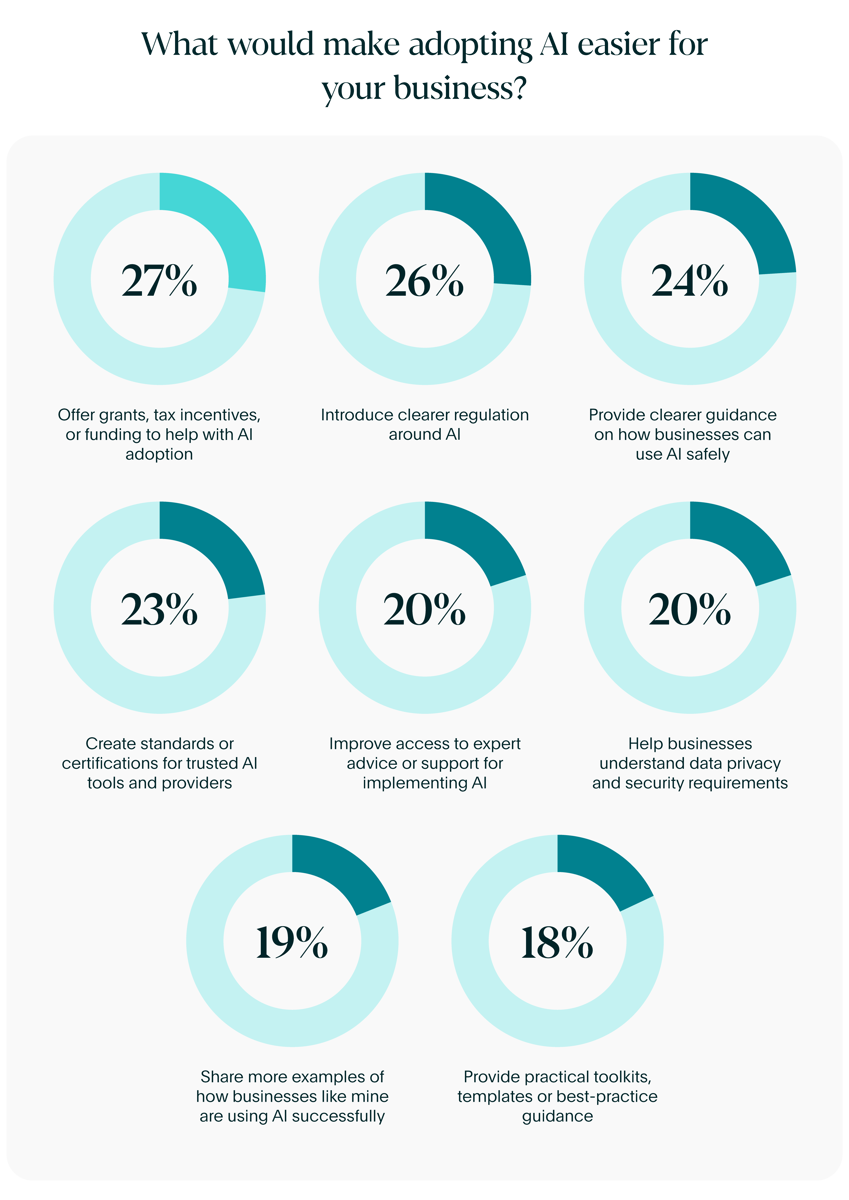
The concerns businesses raised, from data privacy to skills gaps, show exactly where finance leaders need help to make the most of AI. When we asked what would make adopting AI easier, their answers fell into three categories: funding, clear rules, and practical support.
Funding: more than a quarter (27%) would welcome grants, tax incentives, or other financial help with adoption.
Clarity: around a quarter (26%) would like clearer regulation, 24% are looking for guidance on using AI safely, and 23% would value standards or certifications for trusted AI tools and providers.
Practicality: a fifth (20%) would like better access to expert advice, and the same share would like help understanding data privacy and security requirements.
Making AI work, safely
AI is not a passing trend. As one financial services business told us, ‘AI is becoming more and more important to daily tasks’, even if adapting ‘has taken quite a lot of resources’.
The benefits are clear, especially when it comes to saving time on admin and routine tasks. But to make the most of them, businesses need help with upfront investment, clearer rules, and practical guidance to implement AI safely and responsibly.
Diversify your business cash without the admin
With the right support in place, AI could save businesses significant time and money on admin and routine tasks. But some time savings are already within reach – starting with how you manage your business cash.
With Flagstone, you can open and manage hundreds of savings accounts from 50+ banks in one place. All with a single application, and a minimum deposit of £50,000, which you can spread across GBP, EUR, and USD.
<h2> Businesses are asking for guardrails and practical support </h2>
The concerns businesses raised, from data privacy to skills gaps, show exactly where
finance leaders need help to make the most of AI. When we asked what would make
adopting AI easier, their answers fell into three categories: funding, clear rules, and
practical support.