The hidden cost of keeping your business cash with just a few banks
Almost three in four SMEs save mostly with high street banks, and most see them as the safer choice. Yet many may be leaving cash unprotected and earning less than it could.
This article is not advice. If you would like to receive advice on your business' cash reserves, consider speaking to a Financial Adviser.

Ask a finance director what matters most for their business cash reserves and the answer is usually safety. Our research backs that up*.
75% of SMEs say it’s more important to prioritise the safety and protection of their company’s cash, even if that means generating lower returns.
Many businesses choose to save with high street banks. They're trusted, familiar, and convenient. But keeping cash with just a few banks may be leaving some of it unprotected and earning less than it could.
High street and challenger banks: where SMEs hold their savings
High street banks are the well-known names with a long history of branches across the country. Challenger banks are newer and operate mostly or entirely online. When it comes to their cash reserves, our research shows most small and medium-sized enterprises stay with the familiar names.
Almost three in four businesses (72%) save mostly or entirely with high street banks. A further 13% split their funds roughly evenly between high street and challenger banks, and 13% save mostly or entirely with challenger banks.
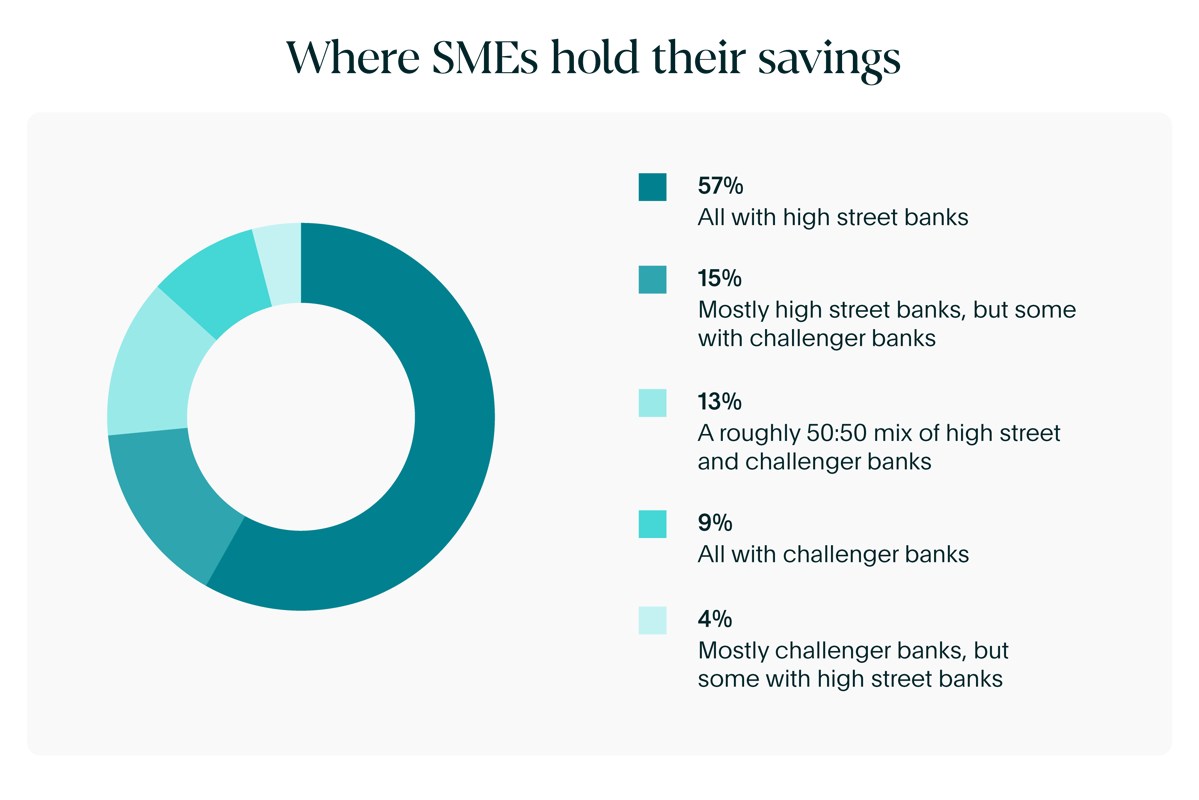
That preference holds even though challenger banks tend to pay more. On Instant Access business savings accounts, for example, four of the UK's largest high street banks pay an average of 1.14% AER, compared with an average of 3.79% AER at four of the highest-paying challenger banks**.
What's driving this preference?
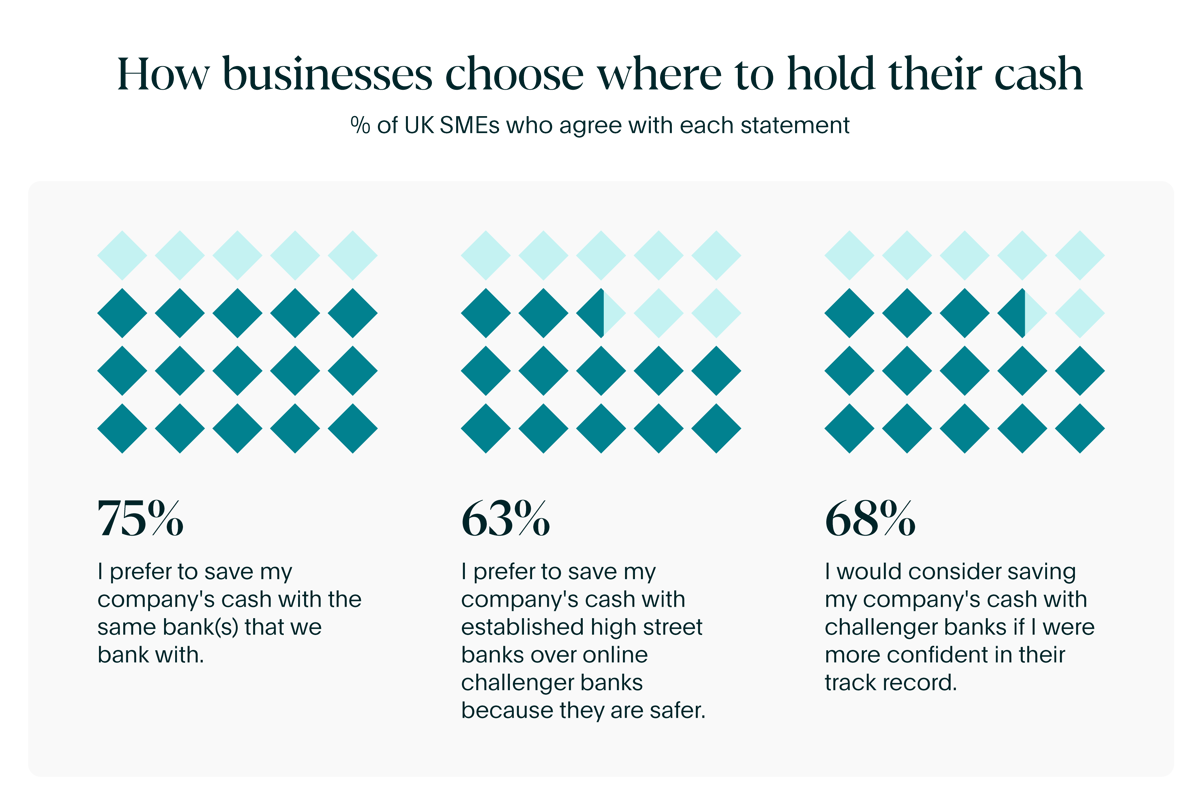
Convenience and trust both play a big part. Three in four businesses (75%) prefer to keep their cash reserves with the bank they already use every day, and 63% prefer high street banks because they see them as safer.
Challenger banks have not yet won that same trust – 68% would consider saving their company's cash with one if they were more confident in its track record.
But staying with what's convenient and familiar can create concentration risk, leaving some cash unprotected if a bank were to fail.
Many businesses hold cash beyond the FSCS limit
The Financial Services Compensation Scheme (FSCS) protects eligible deposits up to £120,000 per individual, per banking group. If a business holds more than that with one banking group and the bank fails, any cash above the limit is not covered.
Our research suggests that while safety is a top priority for most SMEs, many hold more with a single bank than the FSCS covers:
Small businesses hold an average of £225,000 in cash reserves, yet 43% save with only one bank. A business holding that amount with a single bank would have nearly half of it beyond FSCS cover.
Mid-sized businesses hold an average of £621,000 in cash reserves, but 85% use three banks or fewer. Even spread evenly across three, that would leave around £87,000 per bank beyond FSCS cover.
Awareness is high among SMEs, with 72% saying they understand how FSCS protection for businesses works and 79% aware of the risk of holding more than £120,000 with one bank.
But the larger the balance, the more banks it takes to stay within those limits, and the more admin that brings. For many, that effort is what holds them back.
60% of SMEs know they could use a number of different banks to spread risk and maximise returns, but they do not have the time or find it too complicated to manage.
Holding more than the FSCS limit with one bank may feel like an acceptable risk. 68% agree that their company's cash is protected because it's held with banks that have good credit ratings and are unlikely to fail.
A strong rating does lower the chance of failure. But as Lakhbir Sandhu, CFO of Flagstone, points out, it does not remove risk altogether.
When risk mitigation ranks so highly among SMEs, finding ways to ensure adequate FSCS protection on their cash should be a priority for finance leaders. While the financial services industry has more guardrails than ever, it's not a market exempt from risk.
Diversify cash without the usual admin
Spreading cash across multiple banks does not have to mean added complexity. With Flagstone, you can open and manage hundreds of savings accounts from 50+ Fitch-rated, FCA-regulated banks. All with one application, and a minimum deposit of £100,000.
See why 10,000+ business clients trust Flagstone.

* Market research by Flagstone & Opinium among 500 UK SMEs, February 2026
** Market research by Flagstone of four high street banks (NatWest, Lloyds, HSBC, and Barclays) and the four challenger banks offering the most competitive rates on Instant Access at the time (Hampshire Trust Bank, Cynergy Bank, Shawbrook, and United Trust Bank). Rates correct as of 7 October 2026. Rates are variable, so banks can change them.