How can you grow your money when the base rate is on hold?
The Bank of England has held the base rate at 3.75% for a third consecutive month. Learn what drove the decision and how you can take advantage of this outcome.
This article is not advice. If you would like to receive advice on your savings and investments, consider speaking to a Financial Adviser.

Bank of England base rate: at a glance
- The base rate remains at 3.75% following today’s Monetary Policy Committee (MPC) meeting.
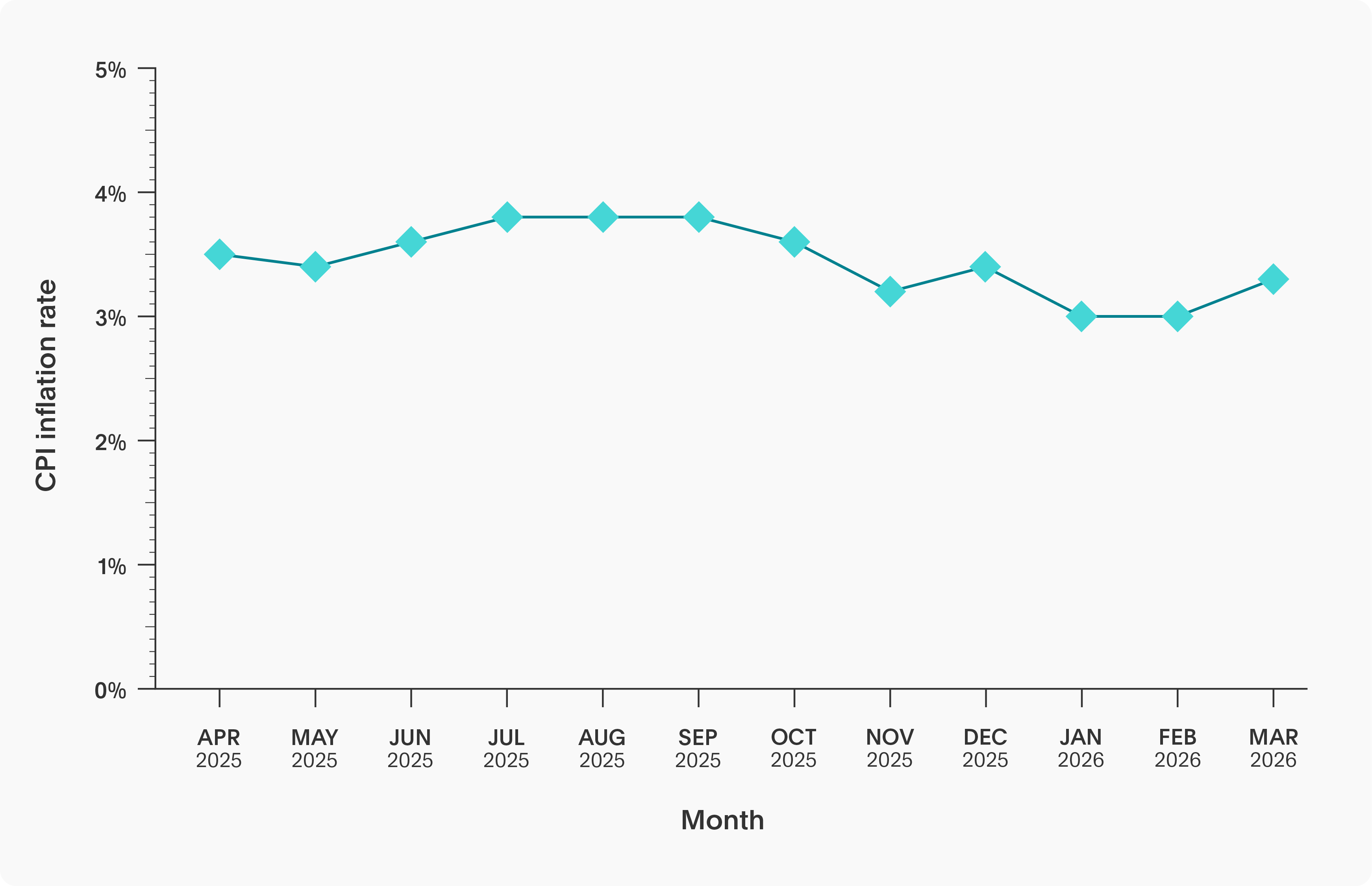
- UK inflation rose to 3.3% in March (up from 3% in February), driven by higher energy costs as a result of the conflict in the Middle East.
- Uncertainty around energy prices has made the near‑term inflation outlook harder to predict.
- Interest rates continue to perform strongly, with many banks offering inflation-beating returns on both instant and fixed savings accounts.
- The next Bank of England base rate decision is on Thursday 18 June 2026.
The Bank of England has held the base rate at 3.75% for the third month in a row, with an 8-1 vote. The MPC said heightened uncertainty around the scale and duration of the energy shock has made the path for inflation harder to predict.
We think this is a reasonable place given the situation of the economy and the unpredictability of events in the Middle East.
Why did the Bank of England hold the base rate?
Today’s decision was accompanied by the Bank of England’s first full Monetary Policy Summary and economic projections since the conflict in the Middle East began, which set out the key reasons behind the hold.
The MPC highlighted several factors:
- Disruption to global energy supply has pushed prices higher, raising costs for households and businesses.
- Inflation is expected to be higher than previously forecast in the short-term, with risks increasing if the disruption persists.
- Higher energy costs could weigh on economic activity, as households and businesses have less to spend elsewhere.
- Monetary policy cannot control global energy prices, but the MPC said it will act as needed to ensure inflation returns sustainably to the 2% target.
- The MPC said it is monitoring developments closely and will act as needed to keep inflation on track over the medium term.
Official figures released last week show UK inflation rose to 3.3% in March, its highest level in three months, driven by higher fuel costs linked to the conflict in the Middle East. The Bank now expects inflation to sit between 3% and 3.5% over the next few quarters, higher than previously forecast.
Could the base rate rise in 2026?
The Bank held the base rate this month but said the outlook has become more uncertain.
If higher energy prices persist – and begin to feed through into wages and prices – the Bank said it may need to respond to keep inflation on track. At the same time, it noted that weaker growth and a cooling labour market could still help ease pressure over time.
For now, the MPC has made it clear that there is no set path for interest rates. Future decisions will depend on how the energy shock unfolds in the months ahead.
What does today's decision mean for your money?
Commenting on the vote to hold the base rate, Katie Horne, savings expert at Flagstone, says:
‘Savers are currently awash with options to make inflation-beating returns on their cash. A vote to keep the base rate at 3.75% means competition among banks for savers' cash will remain high. Banks will have to continue to fight for every pound in savers' pockets in this higher-than-planned interest rate environment.
‘Traditionally by this point in the ISA cycle, banks remove products from offer and savers enjoy the last of their introductory bonus rates.’
This year, record numbers of Cash ISA rates are still on the market as banks cater to high demand from savers for ISA deals before the Cash ISA threshold falls to £12,000 next April.
‘If inflation continues to rise, the margin between the inflation rate and top savings rates will tighten, making it harder to guarantee that inflation-busting return. Locking cash you won't need for two or more years into some of the market's best longer-term fixed-term deals could reduce that risk as you ride out this tumultuous market.’
Could you be earning more from your money?
Bank of England data shows that over £1tn in UK savings is ‘sleeping’ in low-interest accounts. When cash is left to languish, it’s savers like you who pay the price.
If your cash has been in the same account for several months, it’s worth checking whether the interest rate still reflects current market conditions.
Loyalty to old accounts often doesn’t pay off. Watch Daisy McAndrew explain why in our short video.
Control without complexity
The base rate may be holding steady, but that doesn’t mean your savings should stand still.
With interest rates remaining strong, knowing what rate you’re earning – and whether it’s still competitive – matters more than ever. Staying on top of your interest rates doesn’t have to mean juggling multiple banks or spending hours comparing options. That’s where Flagstone comes in.
With access to hundreds of savings accounts from over 65 banks, you can compare, switch, and track savings performance. All in one platform, with one password.

Three steps to consider next
- Review your rate: If the rate on your savings account is below inflation, you could be missing out.
- Explore the market: Knowing the top rates gives you a benchmark for how your savings compare.
- Run the numbers: Our interest calculator can help you see the true potential of your cash.
Bank of England base rate FAQs
What is the Bank of England base rate?
The base rate (also known as the ‘Bank rate’) is the UK’s most important interest rate. It’s set by the Bank of England’s Monetary Policy Committee and is primarily used to control inflation. Read our guide to learn more.
What is the base rate today?
The base rate is currently 3.75%.
How does the base rate affect cash accounts?
Interest rates on savings accounts often move in the same direction as the base rate, but providers vary the speed and size of changes.